It takes a village… and one determined volunteer
It takes a village… and one determined volunteer
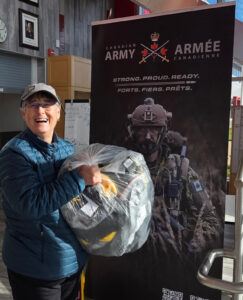
A longtime volunteer, Lori Buchart volunteered at the 2025 Invictus Games in Vancouver and Whistler. As the Games were ending, she was inspired to gather and redistribute thousands of unsold Invictus Games 2025 hoodies, toques, scarves, shirts, jackets, hats and other merchandise to individual serving military members, Veterans and their families, Veteran and military organizations as well as schools across Canada. You’ll read more about that mammoth undertaking below.
Lori initially joined the Canadian Forces Reserve in 1981, under the Summer Youth Employment Program in HMCS Quadra in BC as an on the job trainee. She subsequently re-enrolled in the CF Reserve Force as a Cadet Instructors List Officer, completing 14 years of service that included both part and full-time engagements in Lethbridge, Calgary, Penhold, Esquimalt and Comox. Lori released from the CF Reserve in March 1996.
Lori earned both a Masters in Leadership and Doctorate in Business. During her civilian career as a professor of business at Mount Royal University, she found much success in the classroom, until she was placed on permanent long-term disability in 2015 for recurrent, Complex PTSD.
In March 2026, she is scheduled to take part in the first leg of Full Circle, a 12-week, 2,000-nautical-mile circumnavigation of the UK by two tall ships, carrying the Invictus Games flag around the UK ahead of the Birmingham 2027 Games.
True Patriot Love spoke to Lori the week before Christmas, catching up with her over Teams during a break at the Naval Museum in Calgary, where she volunteers as a Board Member of the Naval Museum Alberta Society. You may also find her in the museum’s workshop doing odd jobs to support museum activities.
Collecting and packaging thousands of items of Invictus Games gear and getting it to Veterans and military families across Canada is an incredible accomplishment! What inspired you to take on a challenge of that size?
While volunteering at the Vancouver Whistler Games, a Veteran reached out to me and asked if I could find him a volunteer shirt; the volunteer clothing was yellow and black and was quite striking. My extra shirt wasn’t the correct size, so I put out a call on the Invictus Games (IG) volunteer Facebook page asking if someone could help… and the page blew up. Many people were saying they didn’t want their clothing or they didn’t want all of it. That got me to thinking: what’s going to happen to all this volunteer clothing after the Games?
What did you do next?
I asked around the IG world if there was a plan in place to collect the surplus clothing and there wasn’t. So, me being me, I set up five collection sites across the country in Vancouver, Victoria, Toronto, two in Ottawa and in Calgary where I live.
First off, I asked Teresa, a very good friend in North Vancouver and fellow Royal Roads University classmate, if people from Vancouver could drop their clothing off at her house. After a few days, she said, “Oh my God, Lori, there is so much stuff here.” There was also a lot being dropped off or sent across Canada to the other drop-off locations. Some packages came from as far away as Australia.
While that was happening, the IG 25 Vancouver team reached out to me and said they had more volunteer clothing and would I be interested in distributing this also. I asked “How much?” and they said, “Oh, not too much.”
My husband and I were coming out to Vancouver, so we went to the office to collect it – and it was a room stacked to the ceiling with boxes. We sorted it and broke it down into bags and stuffed an SUV full – like FULL. I called my brother and said, “Can I store this at your house until I figure out a plan?” I had no idea what to do and we were still collecting Invictus stuff across the country.
While still trying to figure out a plan – which was more than overwhelming – IG 25 Vancouver contacts me again and asks, “Do you also want to take care of the merchandise?” I said, “How much do you have?” Same response: “Well, not very much.”
And you’re thinking, “I’ve heard that before.”
We go to the building and there were boxes upon boxes upon boxes upon boxes – I have never seen so many fanny packs, tuques, scarves, pins and more in one place! The IG team helped break it down into bags. My husband and I are looking at this stuff and thinking, we’re not getting this back to Calgary in this trip. So another phone call to the village to help out.
Susan, my friend who owns Snow Farms, offered her Quonset to temporarily store all the goods while we came up with a plan to get the gear to Calgary. Susan arranged with one of her vendors, Discovery Organics, to bring the clothing to Calgary on one of their vegetable truckloads.
In the meantime, London Drugs, a sponsor of the Vancouver Invictus Games, contacts me and asks if the leftover IG merchandise could be included in this distribution effort. I said sure but I was wondering where the heck I was going to sort and store this stuff. It wasn’t going to fit in my garage!
I then wrote a note to Commander Andreas Paschke, Commanding Officer of HMCS Tecumseh Naval Reserve Unit, and asked if we could use space in their boatshed to sort out all the donations. Once all the gear made it to Calgary through various means, I rented a U-Haul to bring it all to HMCS Tecumseh.
The Executive Officer Lt(N) Steve Charest and Petty Officer 1st Class Marlee Palmer organized the Tecumseh effort, including providing 10 General Duty Officers. They unloaded the truck and there’s gear everywhere and one of them asks, “Where do you want to start, ma’am?” and I just burst out crying for a moment. I had no clue; it was so overwhelming.
Over the course of two days, clothing was sorted by size and type into huge leaf bags, initially putting five of every size of item in a leaf bag. We filled something like 187 huge leaf bags. Then I begged, borrowed and stole hockey bags from family and neighbors to more easily transport the clothing across Canada. During this sorting process, some cadet unit Commanding Officers and contacts also picked up boxes of gear to distribute to cadets in Alberta and BC.
So now you have almost 200 huge bags filled with clothes; how did you get them across the country?
It took a village! It was amazing to watch people come together and use their networks for this cause. Friends and their contacts were my “clothes mules” to distribute the clothing; all I had to do is get the clothing to them. Somebody commented on one of my posts, “Does anyone ever say no to Lori?”
There are so many people who stepped up to help out but my husband, Lawrence, deserves a huge shout out – he got roped into lugging, hauling and packing bags. He was there for the duration.
I used my contacts in my previous life with an airline, and I would take standby flights to deliver hockey equipment bags across Canada. I usually flew with eight big hockey equipment bags at a time, and because I can’t lift or push bag carts, staff or other passengers in the airport would help me. They would ask what I was doing with so many hockey bags so I would tell the story.
It was interesting because people would say, “Oh, my dad served” or “My husband served” so right then and there I would open up the bag and give them a piece of Invictus gear and tell them to thank their person for their service.
My biggest regret is I know that clothing did not make it to every corner of Canada, as hard as the village tried; I know that people were missed along the way and that pains me. This project wasn’t all happiness, although what happened in the end was happiness. My hope is that for future Invictus Games a plan is put in place for leftover merchandise distribution.
Who got the donations?
The bags literally went from sea to sea. Bags were brought to the Veterans Food Banks in Calgary, and they arranged to send some of the clothing to Northern Alberta, the Northwest Territories, and some of the smaller communities in BC they served. Senator Rebecca Patterson took a hockey bag to the Ukrainian embassy in Ottawa for Ukrainian veterans and their families. I would rope in friends to help distribute to the MFRCs in Kingston, Trenton, Esquimalt and other locations. The very last stop being Rear-Admiral Josée Kurtz in Halifax to ensure serving members and their families received Invictus swag.
One of the most unexpected rewards of this project was getting clothing to kids in schools; it provided an opportunity for children to learn about the Invictus Games.
Some serving members or Veterans would take a handful of gear to hand out in their children’s classrooms and talk about military service. In another case, a mother who home schooled her children used it as an opportunity for her kids to do a little research project. I phoned up one of the school principals in Calgary and brought hats, scarves, fanny packs, and shirts for almost 900 kids.
Drops also went to a couple of the Veterans’ villages and door to door to Veterans who weren’t able to leave their homes. The smiles we were met with because their service was recognized by this small token said more than any words could.
What do you wish more Canadians knew about the CAF and Veterans?
Canadians need to make themselves more aware of what a life of service in the military is like. It’s important to understand it’s not just the person in the Forces who serves, it’s also the family who serves, and I think that’s a critical piece that is missing.
I watched my brother serve for 35 years and his wife and kids followed him wherever he was called. Friendships and jobs were paused; tears were shed. There are a lot of things that happen in this dynamic that can be harmful to a family unit. We as Canadians need to be more gentle and compassionate as well as more aware of this and offer whatever support we can.
Was there someone in your life who taught you that giving back is important?
That is a very interesting question. I’ve always had a life of service of some sort. I’ve always been engaged in my community. There was trauma in my childhood, and I was bullied in school so I think it started out as a way of coping so you could feel good, to let go of some of that pain. So it was in some ways about survival and then it just became a way of life. It gives one a purpose to get up in the morning. Serving keeps me on the path to better health.